


Richard Baldwin joined Markus’ Academy. Baldwin is a Professor of International Economics at IMD Business School.
Watch the full talk below. A summary in three bullets:*
In the past we saw two big shifts in globalization. The first shift promoted trade in final goods, while the second promoted trade in intermediate manufacturing inputs. The coming third big shift will be about the growth of trade in services
China is the world’s sole manufacturing superpower. It has become so dominant that other countries have had little alternative than to shift towards exporting services
The recent rise of automation in manufacturing has reduced the importance of developing countries’ comparative advantage from low labor costs. To continue leveraging their comparative advantage, these countries should focus on exporting services
Highlights
[0:00] Markus’ introduction and poll questions
During the recent period of manufacturing-based globalization firms essentially obtained cost efficiencies from outsourcing in exchange for their technological know-how
The West’s approach to globalization led to externalities from competition: firms believed that if they didn’t sell their industry know-how their competitors would do so, making the technological transfer inevitable
The goods- and export-based development strategy has been the only successful one in the past. However, technological protectionism or the desire to make supply chains resilient may change this
Comparative advantages may become less relevant when all countries have the same technology, and scale and network effects may matter primarily
There is a tradeoff between leveraging scale and network effects and overproducing a good. When China subsidizes its electric vehicle sector, is it distorting international trade? or is it generating positive environmental and R&D externalities?
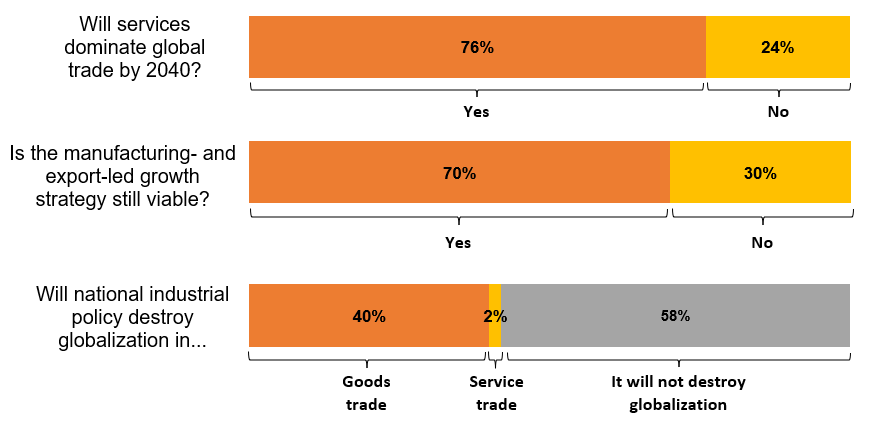
[9:07] The third big shift in globalization
The first major shift in globalization began in the 1820s. Driven by the decline in transportation costs, it facilitated the trade of final goods across markets. It brought a Great Divergence between G7 countries and China and India
The second big shift started in the 1990s, and it promoted trade in intermediate manufacturing inputs. With ICT reducing communication costs, it became easier to move factories across borders to take advantage of lower labor costs. All of the decline in the G7’s share of global manufacturing can be attributed to the growth in the shares of 6 developing countries: China, India, Korea, Indonesia, Thailand, and Brazil
Despite significant growth in previous decades, the share of goods trade in global GDP has remained stagnant since 2008. The third big shift will be about the growth of trade in services
Since 2012 supply chains are becoming shorter, with a decline in the share of intermediate input production in total production. This trend is stronger if we exclude China, where the share of intermediate inputs production in total production has grown
Since 2004 supply chains have been localizing (defragmenting), with a decline in the share of imported intermediate goods in the total intermediate goods used. However the trend is the opposite if we exclude China: in the rest of the world the share of imported intermediate goods in total intermediate goods usage is still growing
China is the world’s sole manufacturing superpower. It surpassed the US’s share of manufacturing output in the late 2000s and has since doubled it. China’s manufacturing output is larger than that of the next nine countries combined
As China is becoming a mega-economy they are replacing their imported intermediate goods with domestic production. At the same time China continues to dominate global supply chains. Despite talks of decoupling, the share of US imports coming from China (directly or indirectly) has continued to grow, while China’s reliance on the US is declining
How is it possible for China to simultaneously close itself while still dominating in manufacturing globally? Its exports and domestic production are both growing, but the latter is growing faster so that exports as a share of domestic production has declined since 2005
With a stagnant trend in foreign direct investment and manufacturing exports, the share of services trade in global trade has been rising sharply since 2010
Although developed countries still dominate global service exports, developing countries have experienced a higher growth in service exports since 2016, particularly in ICT and professional, technical, and administrative services
[30:57] There is no alternative to the service export-led growth model
China has become so dominant in manufacturing that other countries have shifted towards exporting services. There is just no other clear alternative
In the 1995-2008 period most middle income countries pursued a manufacturing- and export-led growth. In 2008-2020 we drastically saw the opposite, with 60% of lower-middle income countries and 85% of upper-middle income countries pursuing a service- and export-led growth model
One major criticism of the service-led export model is that service jobs have lower productivity growth. However, this is not true for most low and middle-income countries (Nayyar et al., 2021)
The shift towards services is not driven by geopolitics. We can think through the shift with a framework inspired by Bloom et al. (2015), where firms endogenously choose the fragmentation of their supply chain so as to equate the marginal cost of fragmentation (harder to coordinate more stages in a complex supply chain) with its marginal benefit (from specialization and the leveraging of comparative advantages)
Until the 2000s improvements in communication technologies reduced the marginal cost of fragmentation, allowing firms to leverage low labor costs
However, the recent rise of automation in manufacturing has reduced the importance of developing countries’ advantage from low labor costs, and has led to shorter supply chains. For example, if everything was produced with 3D printing there would be no point in offshoring production
Leaving aside the potential impact of AI, services remain labor intensive, while it has become easier to trade them, allowing countries to leverage their wage-cost comparative advantage
[47:21] The future of trade is services
When people think about the trade of services, they often focus on final products. However, the majority consists of Business-to-Business intermediate services, such as providing back-office functions
Four facts to motivate the hypothesis that trade in intermediate services will grow much faster than trade in goods for the foreseeable future:
(1) The barriers to trade in services remain orders of magnitude higher than those in manufacturing trade (Benz and Jaax, 2022), to the point that many economists see services as “non-tradable”
(2) However most of the trade barriers in intermediate services are technology-linked, and not policy-linked. In contrast to final services, intermediate services remain largely unregulated, while they are also hard to tax since it is hard to determine where the service was actually provided. Given final service producers’ reliance on cheap intermediate inputs, there is no political economy push to introduce barriers against them
(3) Digital technologies are rapidly lowering the barriers against intermediate services, a trend accelerated by the adjustment forced by COVID-19. One example is simultaneous speech translation eliminating language barriers
(4) There is a large demand for intermediate services in developed countries. Intermediate service inputs account for 30% of France’s total output, while manufactured intermediate goods account for only 11% (Baldwin, 2024). Emerging markets have significant capacity to provide intermediate services, as they are already providing them for their own economy. In China and India business services account for 34% and 19% of employment, respectively
[1:02:32] The emerging market miracle will continue and will be based on services
A conjecture: since time zones matter, Latin America will begin exporting services to the US, while Africa will do so to Europe
If a firm exports intermediate services, it ultimately becomes a part of someone else’s value chain. We will see the emergence of service value chains
Services have lower scale- and agglomeration- economies. They require less infrastructure investment (such as in factories or ports). With just 10-20 employees an SME in a developing economy can become the back-office for a foreign company
The service-based export development model is only meant for middle income countries. It requires stable electricity and internet access, along with access to computers and phones
The comparative advantage is the same one which promoted the export of goods: low cost labor. However by removing the intermediate step of the production of a good, with services this advantage can be leveraged directly
The new development model will look like Bangalore. It will be based on cities and training, rather than on industrial districts and factories. The coastal advantage will be less important
Existing development theories mostly focus on manufacturing or on exporting commodities. We need a new development theory, which may develop as an extension to urban growth theory; we may draw inspiration from Haig (1927)
We need new diagnostics to measure comparative advantages in services. Data on service wages is hard to gather, and need to be adjusted for productivity
[1:11:55] Will AI undermine the service- and export- based development model?
Recent evidence suggest artificial intelligence and technologies promoting remote work are complements (Baldwin and Okubo, 2023)
Baldwin’s work-in-progress book speculates that generative AI will be a great equalizer. Recent evidence suggests AI levels up workers’ skills, especially for the worst workers. As a result, AI will be similar to the industrialization of 1870-1970 in that it will raise the productivity of the middle class. It will also make domestic and foreign workers more substitutable. The latter will be able to leverage technology that was trained on the best practices of G7 workers
AI may be like Microsoft Office. All companies will adopt it, and it will improve the quality and timing of service delivery without worsening inequality and without bringing much job displacement
Emerging countries’ investment into ports and export facilities may be a waste of resources. Manufacturing is not going away: it will just become less labor-based and less traded
* Summary produced by Pablo Balsinde (PhD student, Stockholm School of Economics)