

The Second China Shock - Why Europe is the Front Line
Brad Setser | Episode 165-2

Today we post the second part of Brad Setser’s talk on the Second China Shock and the Second Coming of Global Imbalances.*
Recap of Part 1
The Financial Times’ Martin Wolf wrote an insightful piece on Part 1 (available here).
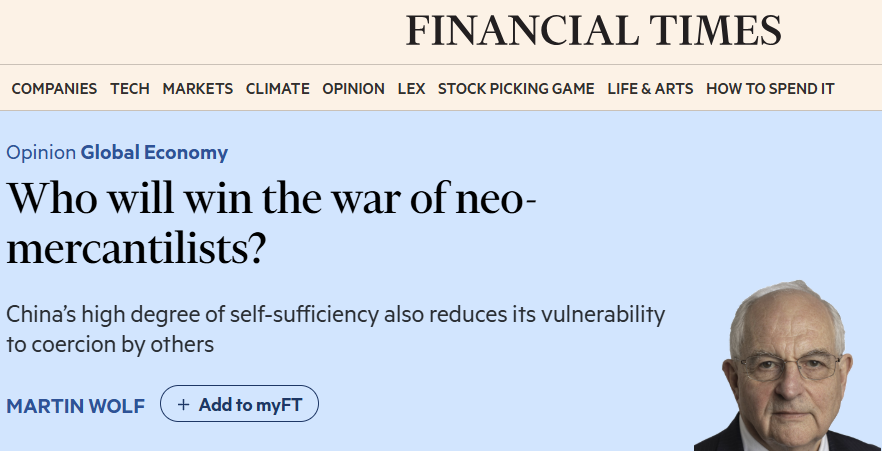
Wolf highlighted some of Setser’s central claims: that China’s exports are surging while domestic demand has stalled, that its manufacturing surplus is now around 2% of world GDP (roughly twice the largest Japan ever ran), and that the unexplained $125bn deficit on China’ investment income account hides a much larger true surplus, implying an even more severe undervaluation of the renminbi of around 30%.
Wolf also closed with Markus’ proposal to measure the “resilience account” in Part 1’s introduction. The current account adds a country’s net exports with its net investment income and its transfers: a deficit means a country is borrowing from the rest of the world. Acknowledging that each good/service is a bundle of (i) the good itself and (ii) a build-up of geopolitical dependency, the resilience account would also net out geopolitical dependencies. How easily could each good be sourced from somewhere else?
Part 2 Highlights
Watch Part 2 and read the summary below. Setser’s slides are available here. A summary in three bullets:
Germany is hit hardest: with its industrial production down ~15%, its export mix overlaps with China’s the most
Autos as the key example: In 2021 China used to import and export 1 million cars. Today it imports 400k and exports 10 million
Without policy change the imbalance will not self-correct, while only China can correct its exchange rate. Setser argues Europe must take the initiative, including through tariffs, to achieve currency adjustment
[0:00] Europe sandwiched, Germany in the crosshairs
German industrial production is down ~15% over the last 7 years, and 20–25% in the sectors most exposed to China. China’s manufacturing surplus has risen ~$1tn, concentrated in machinery, autos and transport equipment, the core of Europe’s industrial base
Export-similarity indices (Finger & Kreinin 1979) show China’s export mix converging on Germany’s and Italy’s far more than on the US’s (de Soyres et al. 2025); German exports to China are down ~1pp of GDP
Net exports are a major drag on German growth; without them the economy would be expanding rather than flat
[17:52] China’s imbalance will not fix itself
Do not trust the IMF when it says China’s current account surplus will decline. For years they have forecasted a surplus decline that never arrives
Compared to other high savings countries (e.g. Singapore, Taiwan, Norway) China’s surplus is small, so it is conceivable that its surplus could grow further.
[22:20] How Europe should act
Policies targeting the financial account like blocking Chinese investment (Klein & Pettis 2020) are hard for the US due to its deficit-financing needs. Europe, which saves more than it invests, has a freer hand
EU leaders have told Xi that the imbalances are unsustainable but continue importing. At some point they will have to back up their threats
The likelier lever is strategic tariffs: lift them if China lets the currency appreciate — with economic coercion (rare earths, magnets) as the tail risk.
The US made a mistake by pivoting from China-targeted measures to across-the-board tariffs
We should build North-Atlantic common markets and pursue joint industrial policy in sectors like autos and pharma. The WTO’s non-discrimination principle no longer fits an economy of China’s size and strategy; new rules would start as US–EU bargains and then generalise to the rest of the world
[39:00] Implications for the rest of Asia
The world is facing three major shocks: the Second China shock, the AI shock, and the Trump tariff shock.
The shocks affect Asian countries differently. Vietnam is the clear winner of the tariff shock as manufacturing assembly relocates there (large US bilateral deficit), offsetting the China shock. Korea is bifurcated, with the AI memory-chip boom offsetting the auto sector squeezed by China
The common thread is that broadly weak exchange rates keep concentrating manufacturing in East Asia
* Setser is a Senior Fellow at the Council on Foreign Relations and a former official at the US Treasury and the Office of the US Trade Representative.
** Hosted by Markus Brunnermeier, with the support of Pablo Balsinde (PhD Student, Stockholm School of Economics).
The three shocks framework is right but understates the interaction between the first two. The AI shock is accelerating the China shock. Chinese manufacturing's cost advantage is being compounded by AI efficiency gains that European industrial firms haven't matched. Germany isn't losing one race on costs and a separate race on AI. The two compound against the same export mix, which is why 15% is probably still the early phase.